

How MyProgress Supports EPAs in Medicine Programmes

Updated: Aug 17
Designing entrustable professional activities (EPAs) is just the beginning. Capturing entrustment decisions reliably, at the point of care, across every placement site — that's where medicine programmes sometimes struggle. Here's how MyProgress closes the gap between the framework and the evidence in front of your progression committee.
Most medical schools now have an EPA framework. Far fewer have a dependable way to capture what happens when a supervisor actually decides a student can be trusted with a task. That gap, between a well-designed framework and the evidence it generates in the workplace, is the single biggest reason EPA programmes stall.
MyProgress, the competency-based ePortfolio from MyKnowledgeMap, is built for that gap.
What are entrustable professional activities, and why are medical schools adopting them?
An entrustable professional activity is a unit of professional practice that can be entrusted to a learner once they have demonstrated sufficient competence to perform it without direct supervision. Rather than scoring abstract competencies, EPAs ask a practical question: can this student be trusted to do this task, and with how much supervision?
An EPA might be obtaining informed consent, prioritising a differential diagnosis, or handing over at the end of a shift. Real units of clinical work, recognisable to anyone who has supervised a student.
That is the appeal to senior educators: EPAs speak the language of clinical practice. Supervisors do not think in domains and descriptors; they think in terms of how closely they need to watch someone. EPA assessment is anchored to an entrustment–supervision scale, running from observe only through act with direct supervision to act with distant supervision, and progress shows as a shift in supervision level over time.
Adoption is now genuinely global. The AAMC published its 13 Core EPAs for Entering Residency in 2014 to address what it calls "a performance gap at the transition point between medical school and residency training." Sweden's seven medical schools collaborated on ten core EPAs for their new six-year programme, and similar work is under way across Canada, the Netherlands, Australia and Singapore.
The case for change is well evidenced. In the Swedish study, 473 clinicians rated those ten activities as important, between 54% and 96%, depending on the activity, but only 6% to 35% believed current graduates could perform them independently. That is the gap EPAs exist to expose and close.
How do EPAs relate to competencies and milestones?
Each EPA is made up of milestones: the individual, observable behaviours along a developmental spectrum that go into performing the activity. Within any one EPA they are bundled together, because that is how clinical work presents itself.
Take prioritising a differential diagnosis. Watching a student do it, a supervisor might feed back on integrating clinical data, identifying possible diagnoses, prioritising and justifying them, and recognising when additional support is needed, behaviours that link back to broader competency areas such as clinical reasoning or interpreting results, but which were all observed in the course of one activity.
That bundling is what makes EPAs workable for supervisors and awkward for programme directors. Some aspects of communication get assessed during a history; others while observing a handover — genuine evidence of the same competence, arriving attached to different activities, at different times, from different observers. So a programme has to answer more than "can this student be entrusted with this activity?" It also has to answer "across everything we have observed, what does this student's communication competence actually look like?"
That is a data problem, and it is where the platform earns its place.
Why do EPA programmes struggle in practice?
EPA programmes tend to fail on execution, not design. Research using normalisation process theory to examine EPA implementation across several countries finds the same barriers recurring:
EPAs become checklists. Supervisors treat them as forms to complete rather than entrustment decisions with consequences for autonomy.
They don't fit the clinical workflow. If capturing an assessment means finding a computer, or remembering until the end of the shift, it happens later from memory, or not at all.
Evidence arrives incomplete. Supervisory practice varies between sites, and committees end up deciding from partial records.
The infrastructure isn't there. The research names patchy digital access and documentation burden as barriers in high- and low-resource settings alike.
The enablers are equally consistent: clear purpose, phased rollout, faculty development, leadership support, and digital infrastructure that fits clinical workflow rather than fighting it.
How does MyProgress support EPAs in medicine programmes?
It captures entrustment where entrustment happens
The MyProgress app works without an internet connection, allowing students and educators to record evidence anywhere. An entrustment judgement is perishable: its value depends on being captured at the point of observation, by the person who made it, while the detail is still fresh.

In hospital basements, rural placements, community clinics and ambulances — where much of the most valuable clinical learning happens — connectivity is unreliable. An offline-capable app removes the most common practical excuse for an unrecorded assessment.
It supports the tools your programme already uses
MyProgress supports Mini-CEX, DOPS, EPAs "or whatever tools your programme uses." Few schools run EPAs in isolation; most blend entrustment ratings with established workplace-based assessments, reflective entries and procedural logs. The platform holds that mix rather than forcing your framework into someone else's template, and that flexibility scales. The National Institute for Health Specialties in the UAE runs MyProgress as a single national platform across its postgraduate programmes, each specialty configuring its own EPAs and procedure logs.
"Through the NIHS ePortfolio, we have brought together postgraduate programs on a unified national platform. Its flexibility enables each specialty to seamlessly integrate Competency-Based Medical Education through Entrustable Professional Activities and procedure logs tailored to their specific training needs. This milestone marks a new chapter of innovation and excellence in postgraduate medical education across the UAE." Dr Mohamed Al Houqani, Secretary General, National Institute for Health Specialties (NIHS), UAE
The same principle applies within a single school: one framework, configured differently for different phases, specialties and placement types, without running separate systems.
See MyProgress' NIHS ePortfolio for EPAs in action here:
It unbundles milestones into a competency picture
Students gather evidence, receive feedback, and map completed assessments directly against your learning framework, so each supervision level becomes a point on a trajectory rather than an isolated form.
The more valuable move happens underneath. Because milestones observed during an EPA are captured individually and mapped to your framework, MyProgress can show how those bundled observations contribute to the whole. Communication milestones recorded during a history-taking encounter and during a handover stop being two unrelated forms and become two contributions to one view of that student's communication competence.
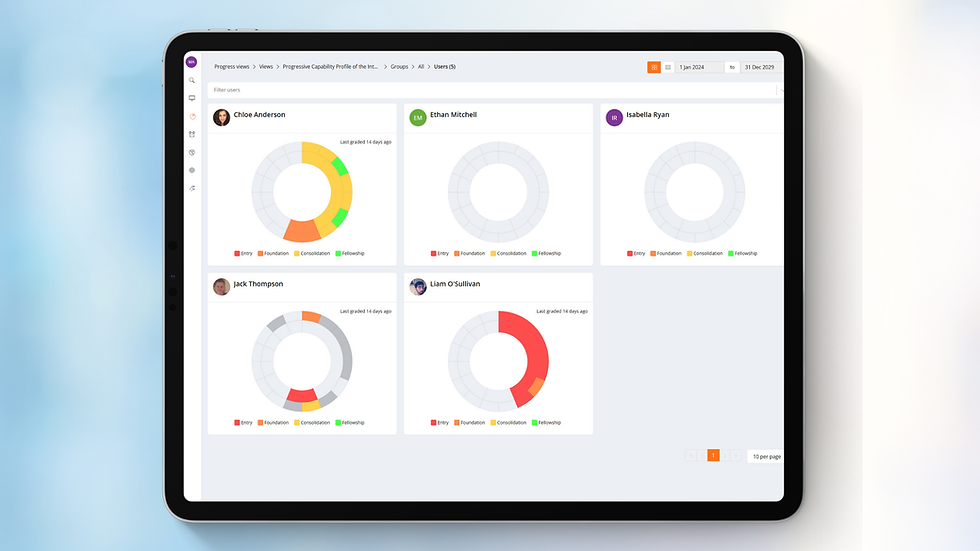
For the supervisor, nothing changes: they observe one activity and comment on what they saw. For the programme director, everything changes. You can answer the competency question: is this student developing as a communicator, a clinical reasoner, a professional?, without asking anyone to assess competencies in the abstract, or hand-collating evidence from a dozen forms.
It shows programme leaders where students actually are
MyProgress gives at-a-glance insights into cohort performance, letting programme teams identify at-risk students early and intervene with targeted support, and letting entrustment committees work from a complete evidence base rather than an anecdotal one.
Patterns also become visible at cohort level, which is the benefit senior leaders tend to value most. If handover is barely being observed anywhere, or one site consistently rates students two supervision levels above everyone else, you can address it while the cohort is still in the programme rather than at the end of the year.

It makes the record defensible
EPA frameworks carry a specific reporting burden: you must show not only that students met the standard, but that entrustment decisions rested on adequate documented evidence, made by identifiable assessors.

MyProgress generates customisable reports tailored for accreditation bodies, and handles the assessor side through verification and confirmation — a point users raise directly:
"MyProgress provides a highly intuitive and flexible ePortfolio solution, with clear colour-coded tracking that gives instant visibility of student progress and competency against GMC requirements. Its seamless use across mobile and desktop supports real-time bedside assessment and detailed feedback, while automated assessor verification and email confirmation strengthen governance and reduce risk. Customisable forms and easy search functionality further enhance usability, enabling efficient, audit-ready tracking of both procedural skills and professionalism with minimal training required." Dr Harri Pritchard, Senior Clinical Lecturer, North Wales Medical School
The regulator named there is the GMC, but the principle travels. Whether you answer to the GMC, the LCME, the AMC or a national framework, the requirement is the same: show that competence was demonstrated, and that the evidence behind each decision is traceable.
What should medicine programmes ask before choosing an EPA platform?
Five questions worth putting to any vendor:
Does it work offline? If it doesn't, expect systematic under-capture from exactly the placements you most want visibility into.
Can it hold our framework? Your EPAs, your milestones, your supervision scale, without redesign.
How long does one assessment take a supervisor? Measure it in taps, not features. Supervisor time is the scarcest resource in the system.
Can milestones roll up into competencies? Otherwise you have activity data but no answer to how a student is developing as a communicator or clinical reasoner.
Is the record defensible? Verified assessors, a traceable audit trail, and reporting built for accreditation rather than a raw data export.
From framework to practice
An EPA framework is a statement of intent. What makes it real is thousands of small entrustment judgements, captured accurately, in the moment, across every site where your students learn — then assembled into a picture the people deciding on progression can actually use.
That is the work MyProgress is built for.
Contact us for more information or to book a demo.
Frequently asked questions
What is an entrustable professional activity (EPA)? An EPA is a unit of professional practice — such as taking a history, obtaining informed consent or handing over a patient — that can be entrusted to a learner once they have demonstrated they can perform it safely at a given level of supervision.
How are EPAs different from competencies? Competencies describe attributes of the learner; EPAs describe units of work in the clinical setting. EPAs integrate multiple competencies into a task a supervisor can observe and make a judgement about, which makes them more intuitive for busy clinicians to assess.
What are EPA milestones? Milestones are the individual, observable behaviours along a developmental spectrum that make up an EPA. Watching a student prioritise a differential diagnosis, a supervisor might comment on integrating clinical data, identifying possible diagnoses, prioritising and justifying them, and recognising when to seek help — each linking back to competency areas such as clinical reasoning or interpreting results.
How can a programme see competency development across different EPAs? Milestones are bundled inside activities, so evidence of a single competency such as communication is spread across several EPAs. MyProgress captures those milestones individually and maps them to your framework, so observations from a history-taking encounter and from a handover combine into one view of that student's communication competence.
How do medical schools assess EPAs? Through repeated workplace observations, each recorded against an entrustment–supervision scale. Ad hoc judgements accumulate into a body of evidence, and a committee makes the summative entrustment decision.
Does MyProgress work without internet access? Yes. The app works offline, so students and educators can record evidence in any clinical environment, then sync later.
How does MyProgress make entrustment decisions auditable? Assessments are captured against your framework at the point of observation, with automated assessor verification and email confirmation, so each decision carries a traceable record of who made the judgement and when.
Who uses MyProgress? MyProgress is used by more than 65 universities and 200 healthcare and veterinary programmes worldwide, with around five million artefacts logged each year.
Sources:
AAMC Core EPAs for Entering Residency — 13 EPAs, published 2014, pilot concluded 2021: https://www.aamc.org/about-us/mission-areas/medical-education/cbme/core-epas
Swedish national core EPAs, 473 respondents, 54–96% importance vs 6–35% independence — BMC Medical Education (2023): https://bmcmededuc.biomedcentral.com/articles/10.1186/s12909-023-04621-6
EPA implementation barriers and enablers (normalisation process theory) — Perspectives on Medical Education: https://pmejournal.org/articles/10.5334/pme.2440

