

Inside Karolinska Institutet's programme-by-programme move to MyProgress

Nine healthcare programmes, one platform, and no top-down mandate. What KI's adoption pattern tells us about how competency-based assessment is changing.
When Karolinska Institutet changes how it assesses learners, health professions educators pay attention. KI is one of the world's leading medical universities, and its Nobel Assembly awards the Nobel Prize in Physiology or Medicine. Over the past few years it has brought MyProgress into its healthcare programmes one at a time. It started in a single discipline and has become an institution-wide pattern. For senior educators reviewing their own assessment infrastructure, how that happened matters as much as the result.
Each programme decides for itself
At KI, decisions about teaching, learning and assessment are made at programme level. They're made by educators who answer to their own regulators, accrediting bodies and clinical partners. A platform approved by one programme gets no automatic endorsement from the next. Each has to be convinced on its own terms.
That's what makes the current picture notable:
Status | Programmes |
Live and embedded | Midwifery, nursing, physiotherapy, dentistry |
Rolling out | Occupational therapy, anaesthesia nursing, dental hygiene, radiation nursing |
Pilot | Medicine |
The number of programmes isn't the point. What matters is that no one mandated the spread. Programme leaders watched what colleagues were doing, judged the results, and chose to move next.
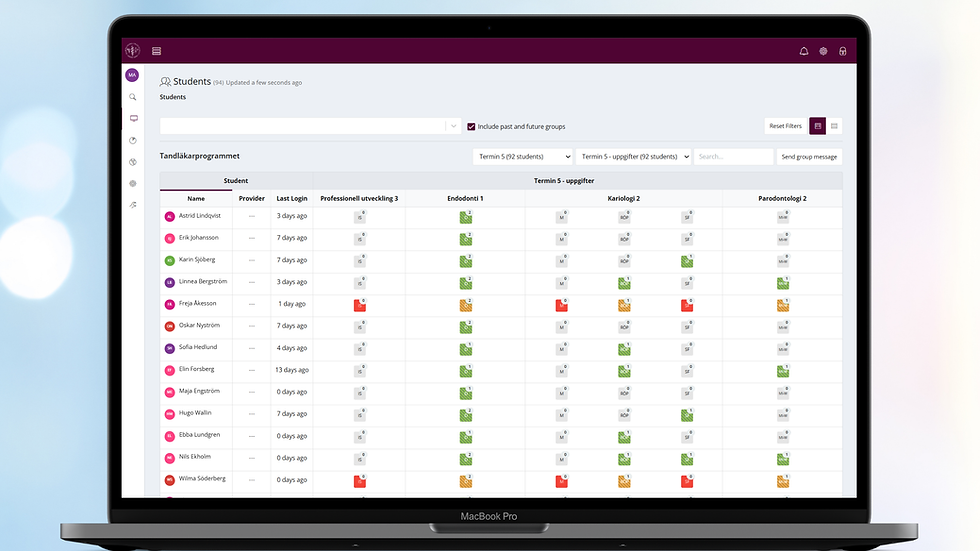
"The dashboards have been revolutionary. We can see where each student is and how they're progressing across rotations and sites, which means we can focus our attention where it's needed." - Linnéa Björkdahl, Karolinska Institutet
Four pressures, one platform
Senior educators will know the pressures behind this. Health professions programmes are managing at least four at once:
A growing evidence base for competency-based education, which needs longitudinal evidence rather than one-off scores.
Regulator and accreditation expectations that are getting stricter.
Clinical placements spread across many sites, where learners and supervisors are rarely in the same place as the programme team.
Demand to use assessment data for programme improvement, not only for individual sign-off.
A workplace-based assessment platform that handles only some of these rarely justifies the cost of change. KI's pattern suggests that its programme leaders see MyProgress doing enough across all four to make the move, and to recommend it to peers.
The range of programmes matters too. Midwifery, dentistry, radiography, occupational therapy and medicine each have different assessment traditions, placement structures, competency frameworks and relationships with their regulators. A platform that fits each context, without forcing them into one mould, reflects how clinical education actually works.
Why now
Several wider trends point the same way:
Competency-based and entrustable professional activity (EPA) frameworks are becoming the default in many health professions. They need evidence gathered over time, not snapshots.
Placements are more dispersed, so paper logbooks and feedback by email look increasingly outdated.
Programmes are being asked to show their workings: not just what they assess, but how they triangulate the evidence behind each judgement.
KI isn't the only institution dealing with this. But its steady expansion, programme by programme, is a good picture of what mature adoption looks like in 2026. It wasn't a single procurement event. It was a series of considered decisions, each owned by the discipline making it.
Lessons for other institutions
Adopting programme by programme is a strength. Letting individual programmes start small and expand on their own timetable lowers the political and operational cost of change. Medicine at KI is doing exactly this, starting with semester 12 students on clinical rotations.
"Our semester 12 medical students rotate through geriatrics, general medicine and emergency medicine. With placement allocation, teachers can filter by group and see the students currently assigned to them, rather than working through the whole cohort." - Linnéa Björkdahl, Karolinska Institutet
The disciplines have more in common than it seems. Allied health, nursing, dentistry and medicine have distinct curricula, but the core assessment need is shared: capturing authentic, longitudinal evidence of learner development in clinical settings. Once one programme has solved that, the next has a working model to judge.
What's next at KI
The second wave of programmes is now bedding in, and the medicine pilot is in progress. We'll share more as each programme is ready to talk about what it's seeing.
For now, the headline is simple. One of the world's most demanding medical universities has made MyProgress part of how it educates the next generation of health professionals, and it did so carefully and discipline by discipline.
See how MyProgress supports competency-based assessment across healthcare programmes, contact us to arrange a demo.


